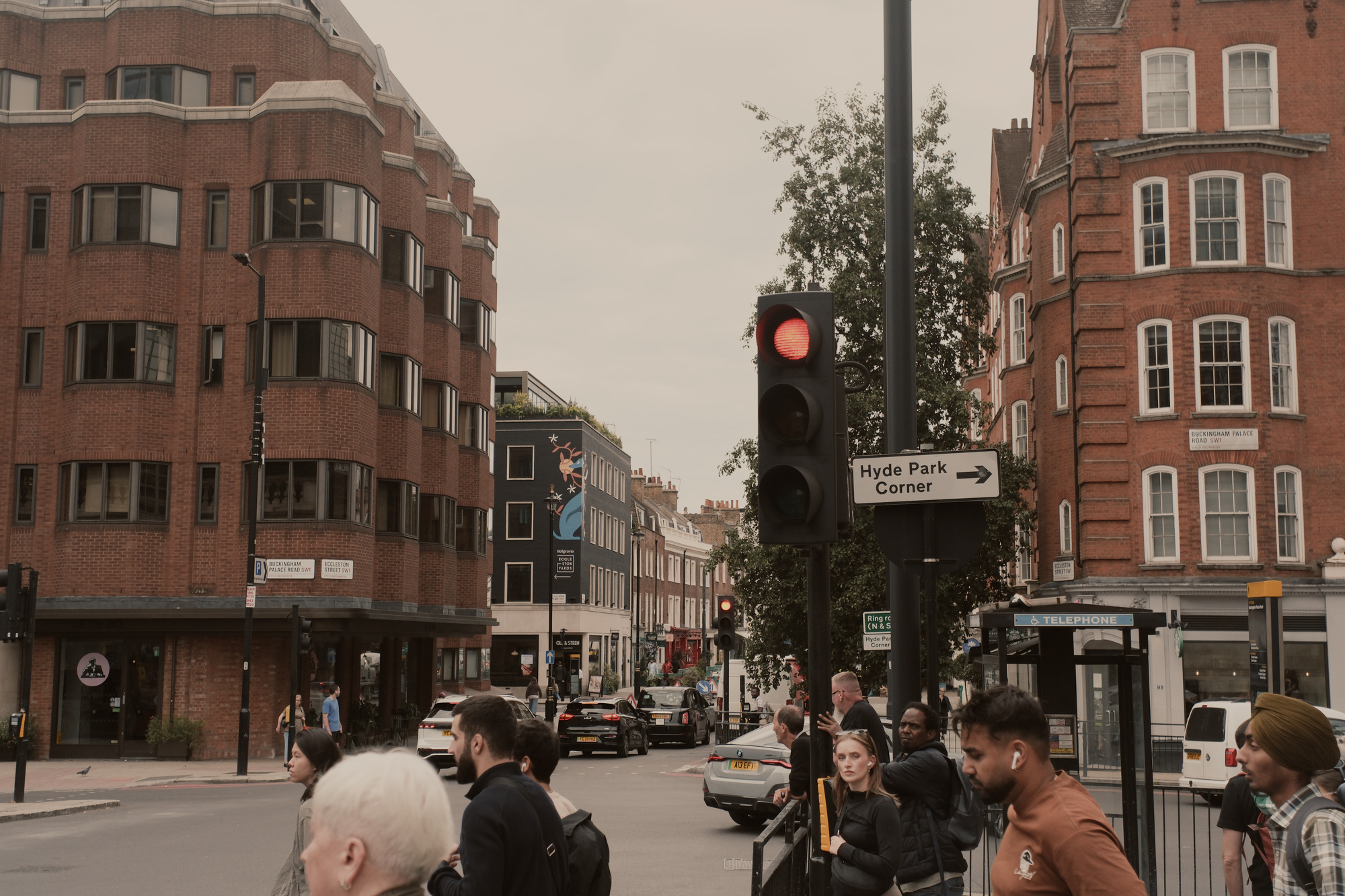
I leave Victoria on Eccleston Street. Traffic backs up at the light. A woman crosses against it, pulling a red suitcase, cutting between a black cab and a delivery van. Scaffolding wraps one corner. A road crew has torn up a section of pavement further down: cones, exposed pipe, barriers.
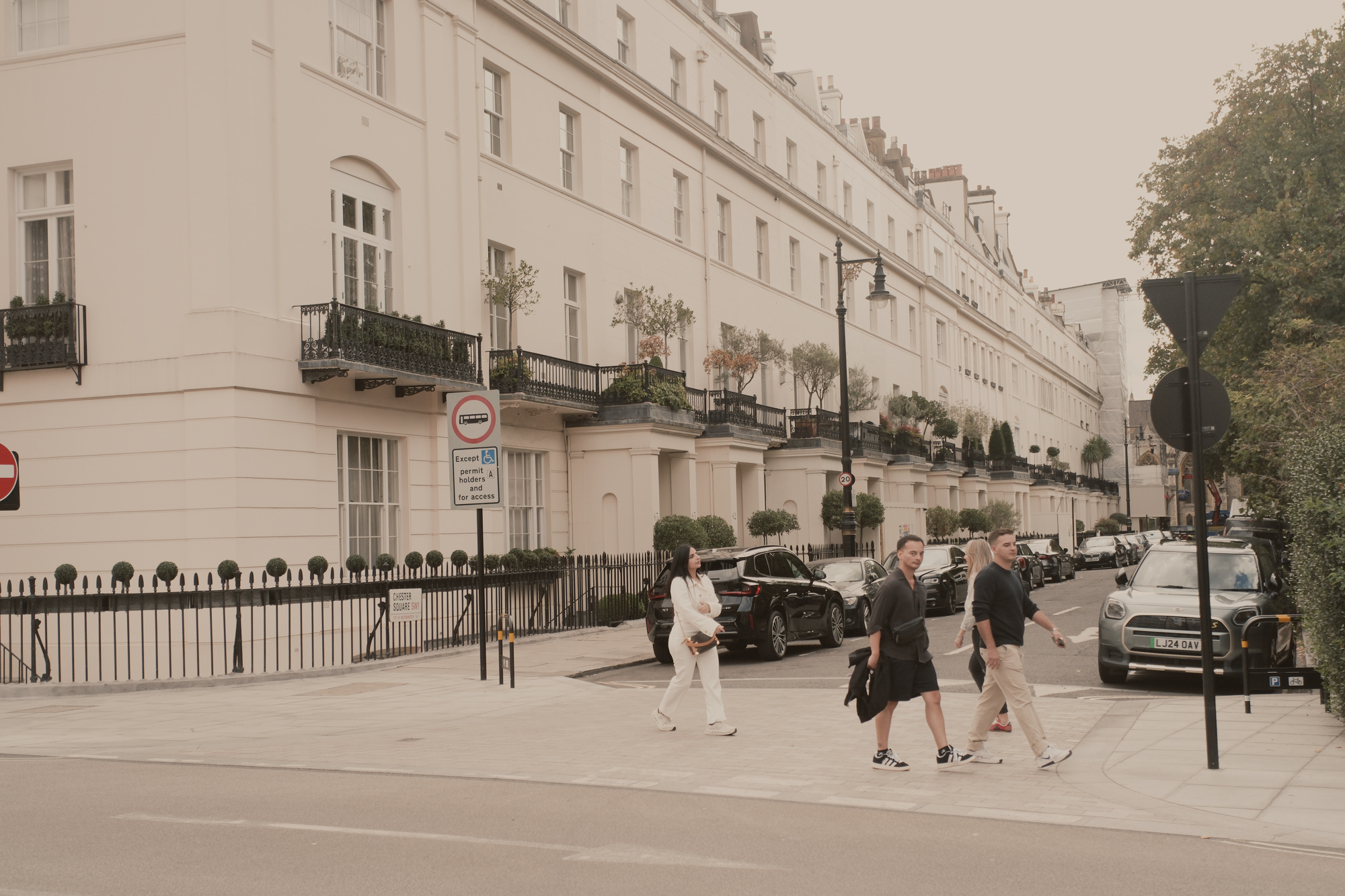
Chester Square arrives all at once. The terrace runs the length of the block without a seam — window after window, portico after portico, black railings holding a line of clipped topiary like a hedge trained into punctuation. It takes effort to find where one house ends and the next begins. A woman in white crosses in front of it with three men behind her, and for a moment the building swallows them the way it swallows everything: they're figures against a wall, not residents of anywhere in particular.
A block over, the wall opens.
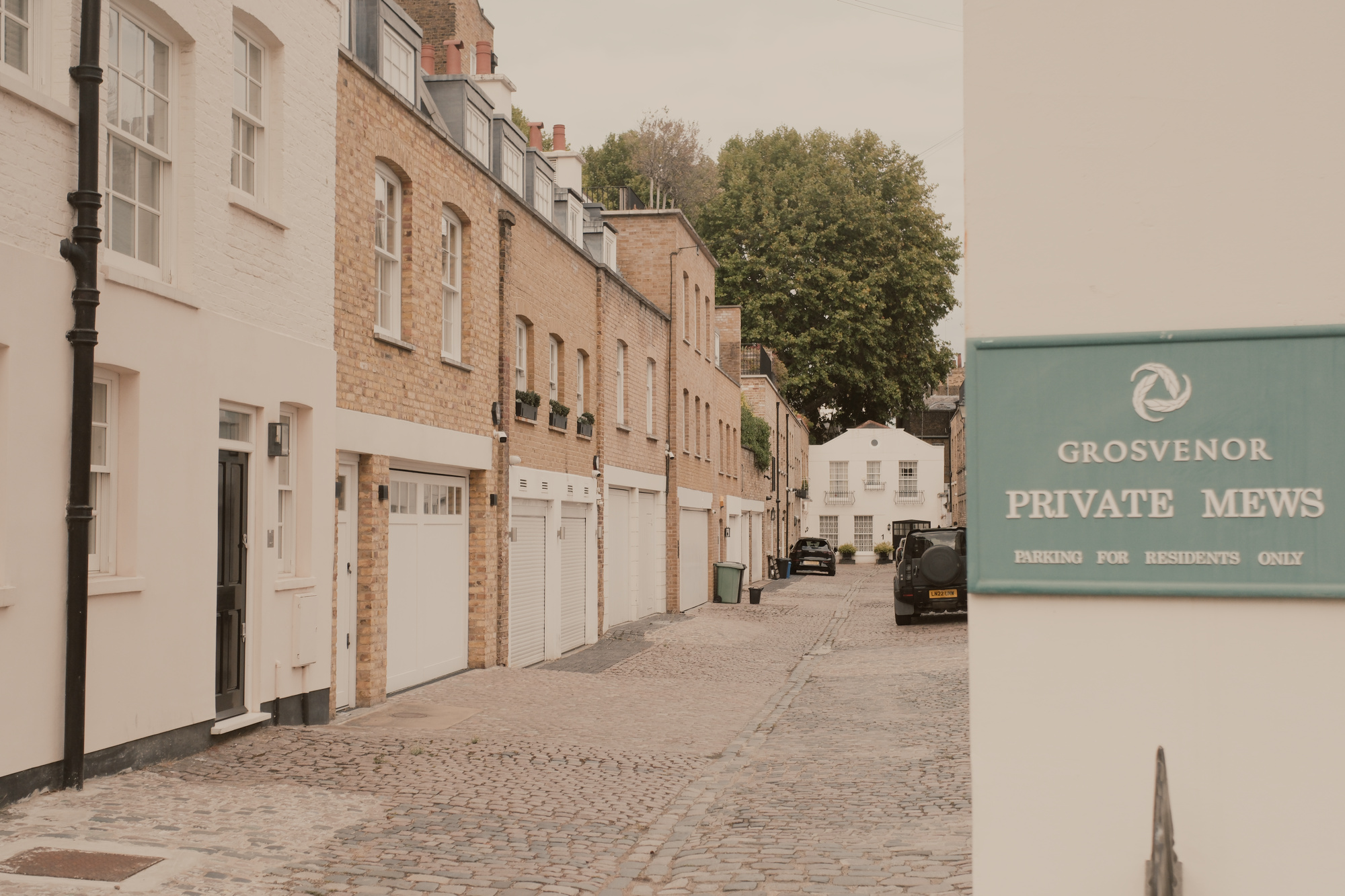
Grosvenor Mews sits behind the terraces like a secret the terraces don't mention. Cobblestones instead of pavement. Brick instead of stucco. Garage doors, not porticos. A sign by the entrance says what it is plainly: Private Mews. Parking for Residents Only. The uniform face I've just walked past has a back, and the back looks nothing like the front.
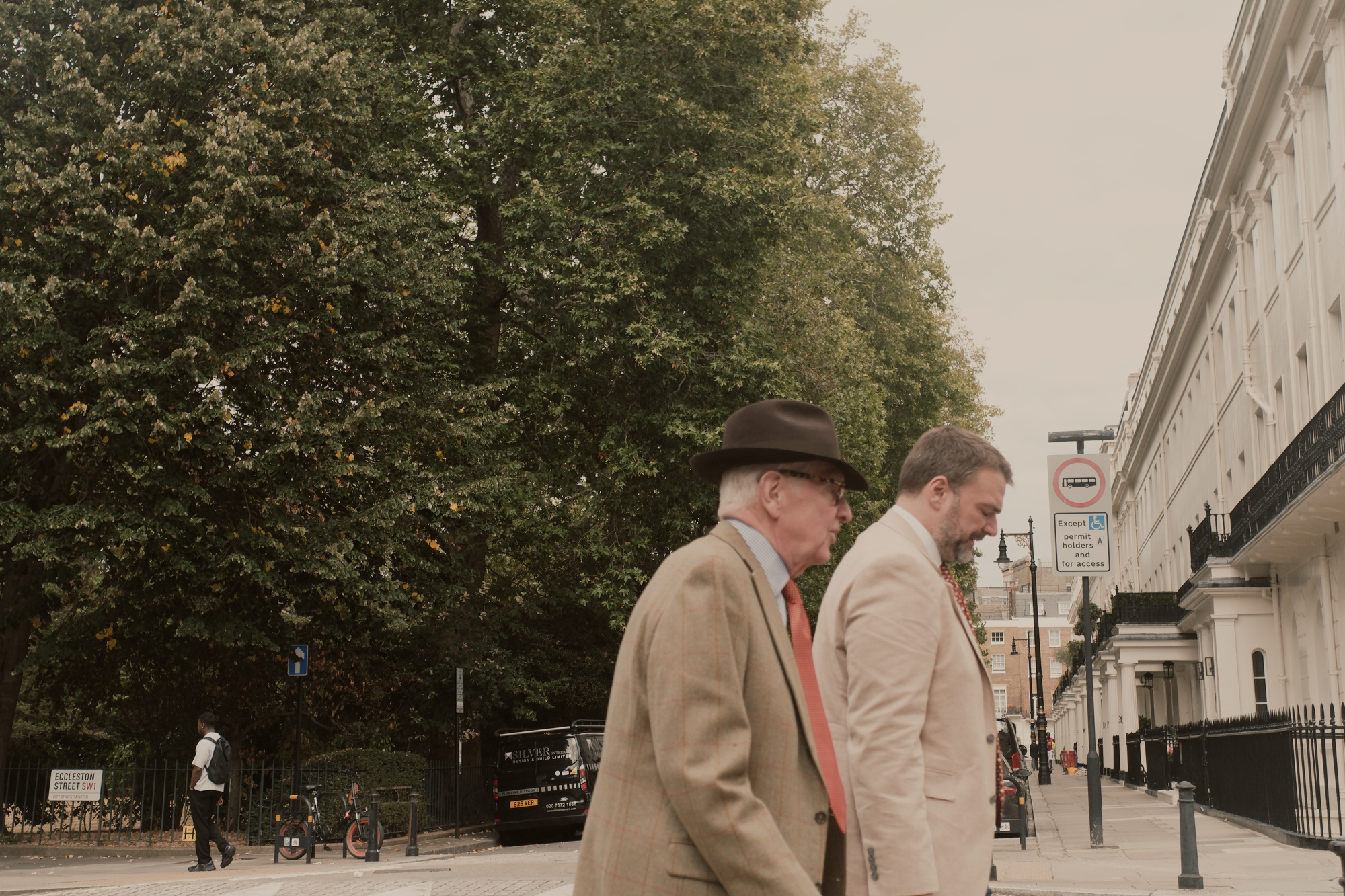
Eaton Square keeps the pattern going. More railings, more private green, more houses that decline to distinguish themselves from their neighbors. But this stretch isn't empty. Two men walk together near the corner, one older in a felt hat, the other beside him mid-sentence, both looking down at the pavement as they talk. A woman photographs something on her phone. The square holds people the way any London street holds people — unremarkably, without ceremony.
And there's a smell here that the railings can't keep out. Something is blooming behind the ironwork, and it reaches the pavement before the eye does — sweet, a little green, entirely uninvited. The garden is inaccessible. The smell isn't.
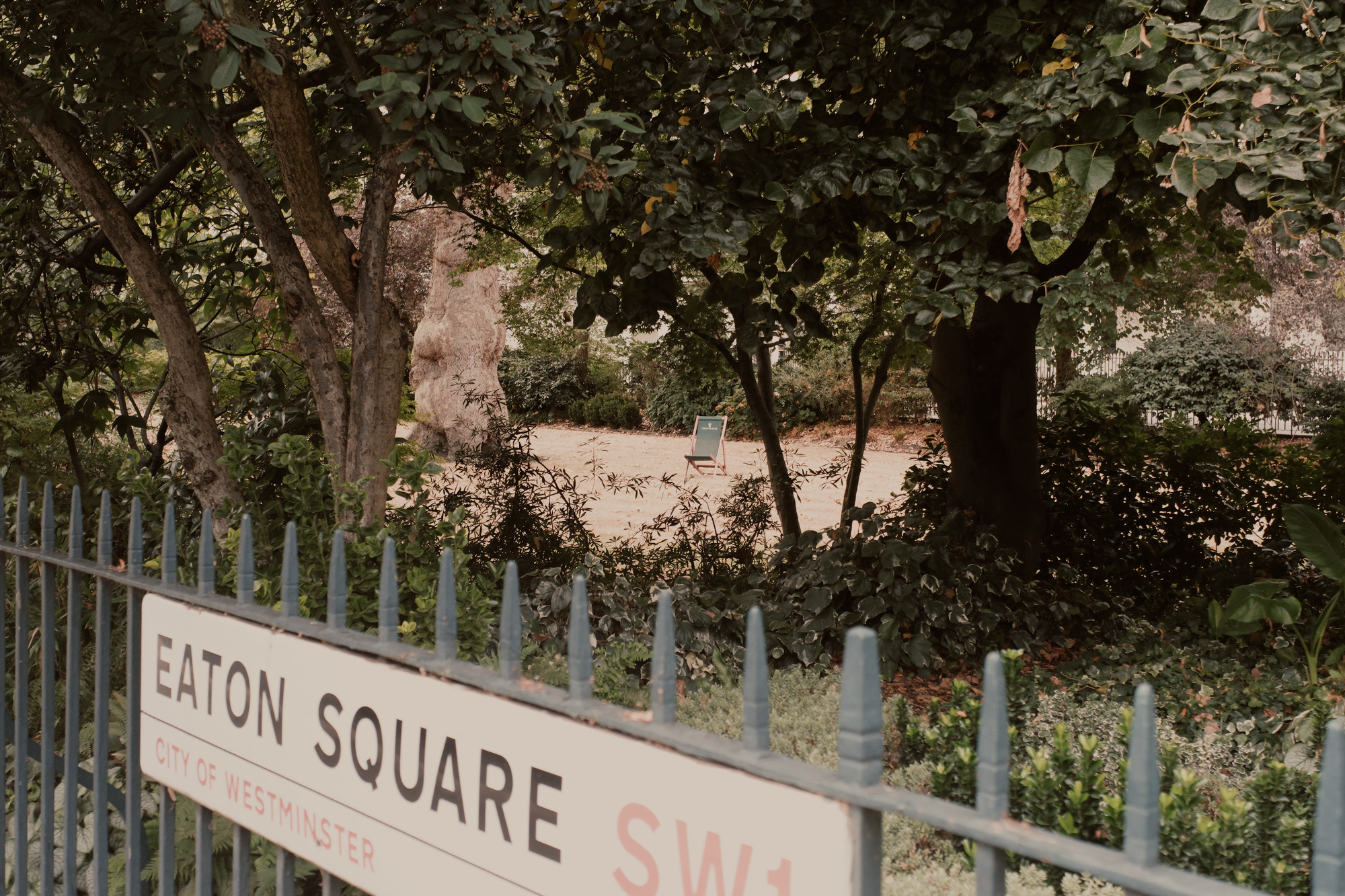
Further along, past a gap in the trees, a street sign reads Eaton Square, City of Westminster, and beyond the railing the ground opens into a clearing of packed dirt, worn pale where grass used to be. A single folding chair sits in the middle of it, facing nothing in particular. The garden is enormous. The chair is alone in it.
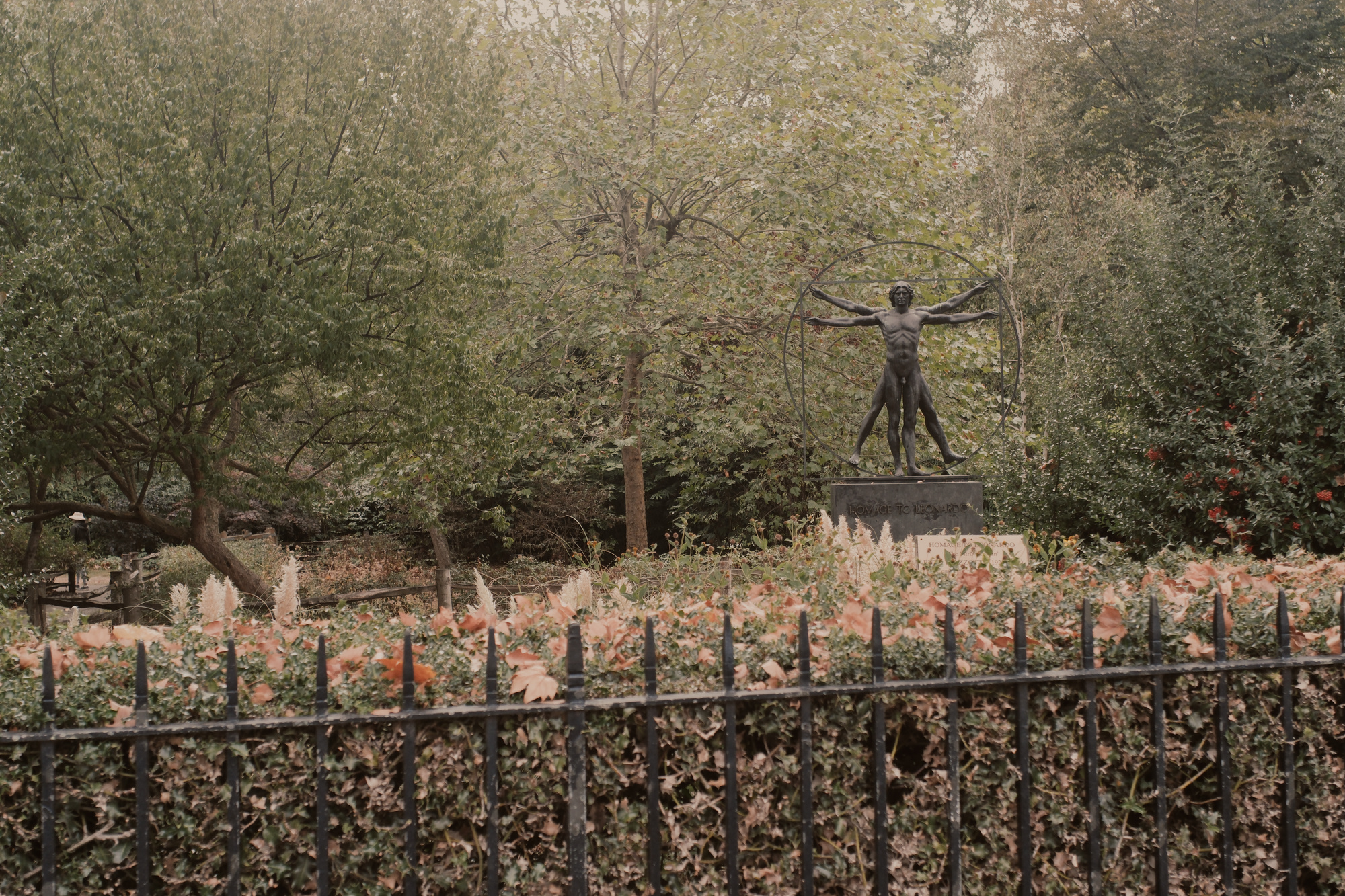
Belgrave Place, then Belgrave Square — the neighborhood's center of gravity, bigger gardens, taller houses, the same railings scaled up. Another private green space, marked as such, kept for residents only. And past another fence, another clearing: a bronze figure stands with its arms spread wide inside a circle, a plaque at its feet reading Homage to Leonardo. Ivy and fallen leaves crowd the railing in front of it. A familiar human shape, arms spread wide, standing alone in a garden.
The formality holds all the way to the curve near Wilton Crescent — a long, pale terrace, symmetrical enough to feel less like architecture than like a diagram of architecture.
Then the street narrows, and everything changes texture at once.
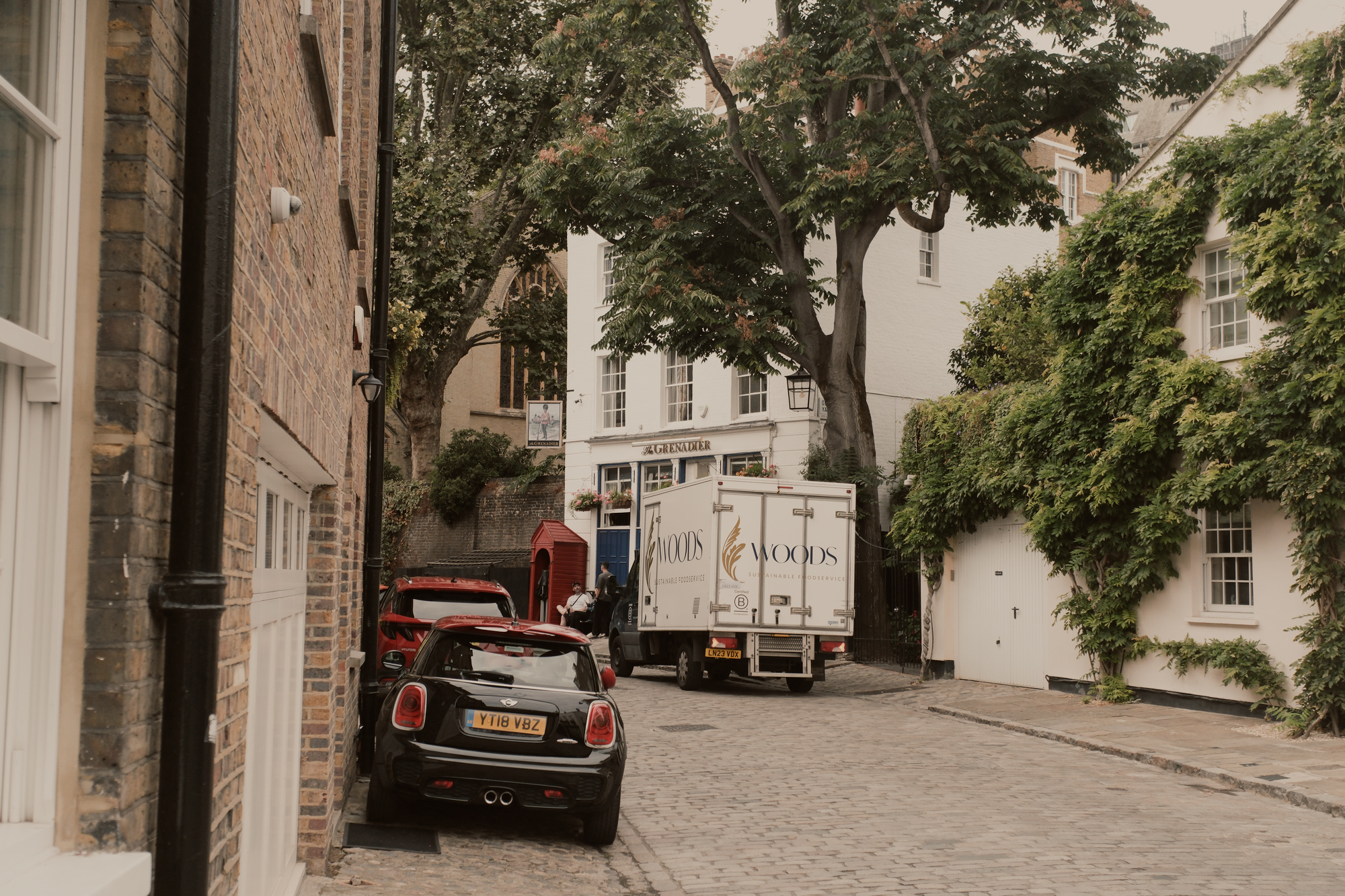
Wilton Row is cobblestone, tight enough that a Woods delivery van barely clears a parked Mini, nose to tail in a lane built for neither of them. Ivy climbs one wall. A security camera watches from another. At the end of it, white-fronted and half-hidden behind a tree, sits the Grenadier — a red sentry box out front, hanging baskets of pink geraniums, a black cab idling nearby with its lights on. People stand at the barrels by the door with drinks in hand. Getting here on foot, threading past the van and the parked cars, is easier than getting here by car ever could be. Not far past it, tucked into a corner where Kinnerton Street bends, a sign reads The Alfred Tennyson — another place that doesn't announce itself from any grand frontage, just sits where it sits and waits to be found.
By the time I reach Elizabeth Street, people are moving and living in the street.
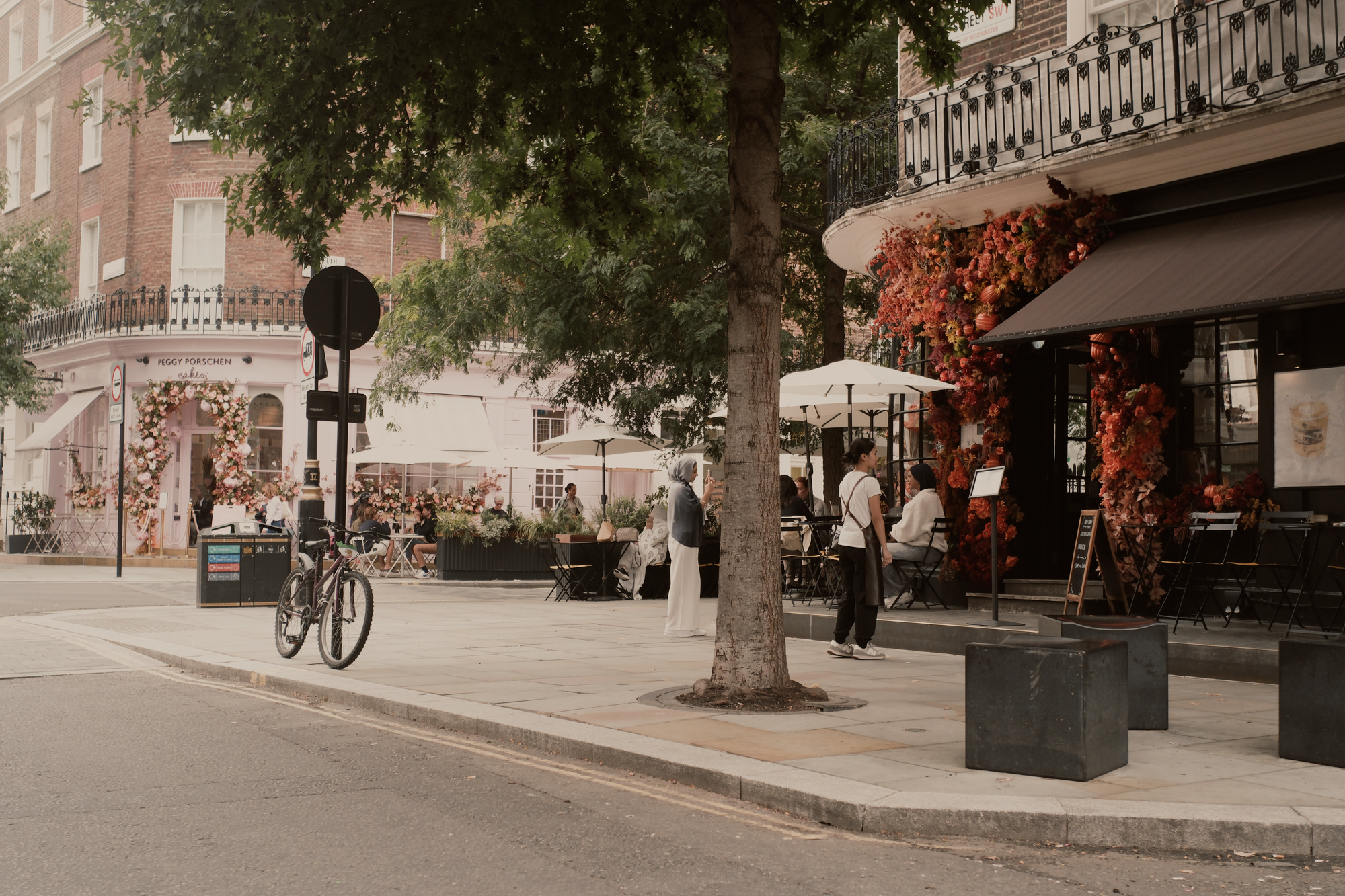
Tables spill onto the pavement. A bicycle leans against a bollard. Red geraniums crowd a planter box outside a restaurant with a green awning. People stand mid-conversation, sit with coffee, walk with purpose or without it.
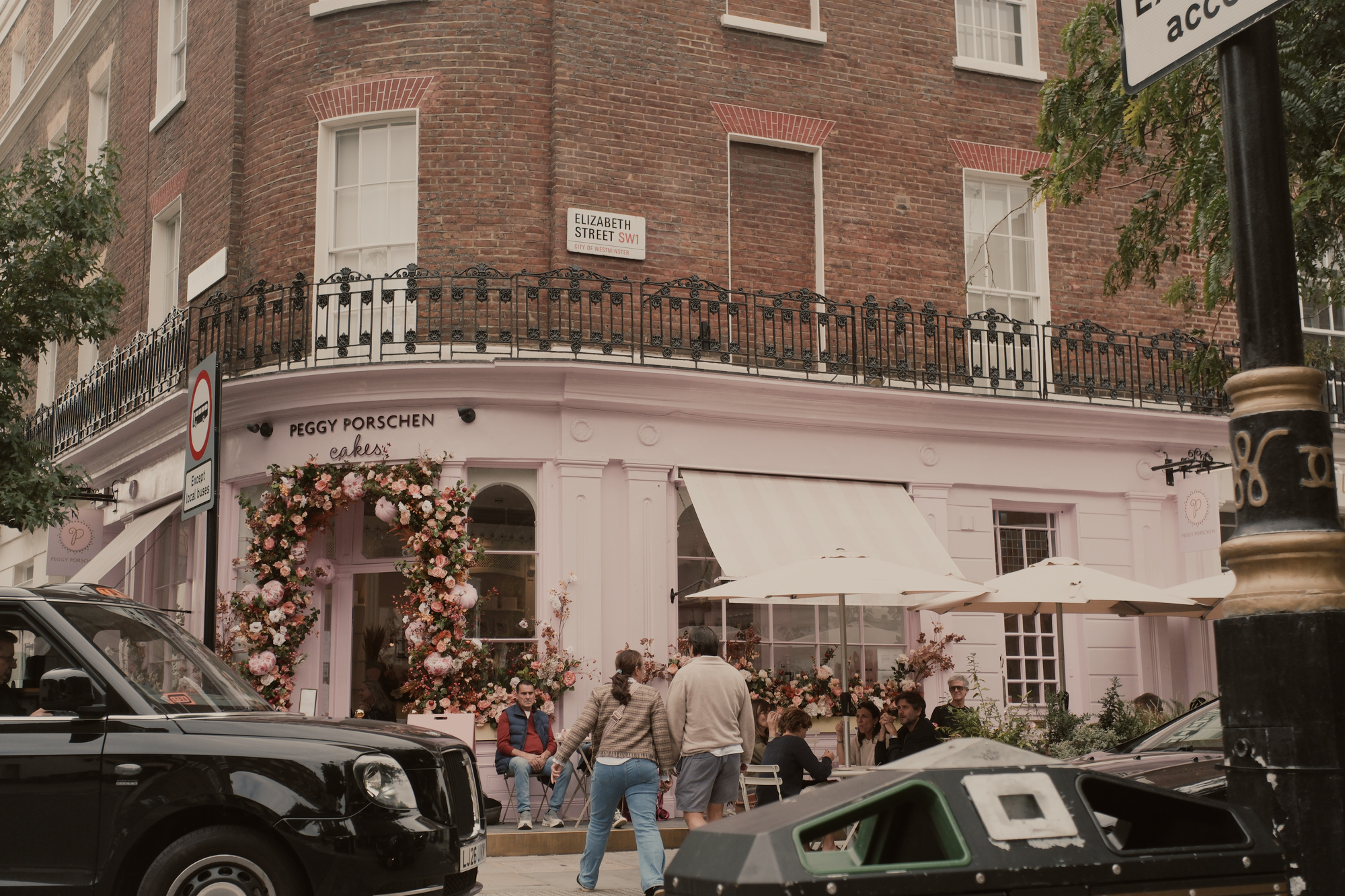
And then, at the corner, Peggy Porschen — pale pink from the sign down to the shopfront, a wall of flowers arched over the door, striped awnings, people at little round tables. After the white and the black iron and the green hedges of the last hour, the corner is pink.
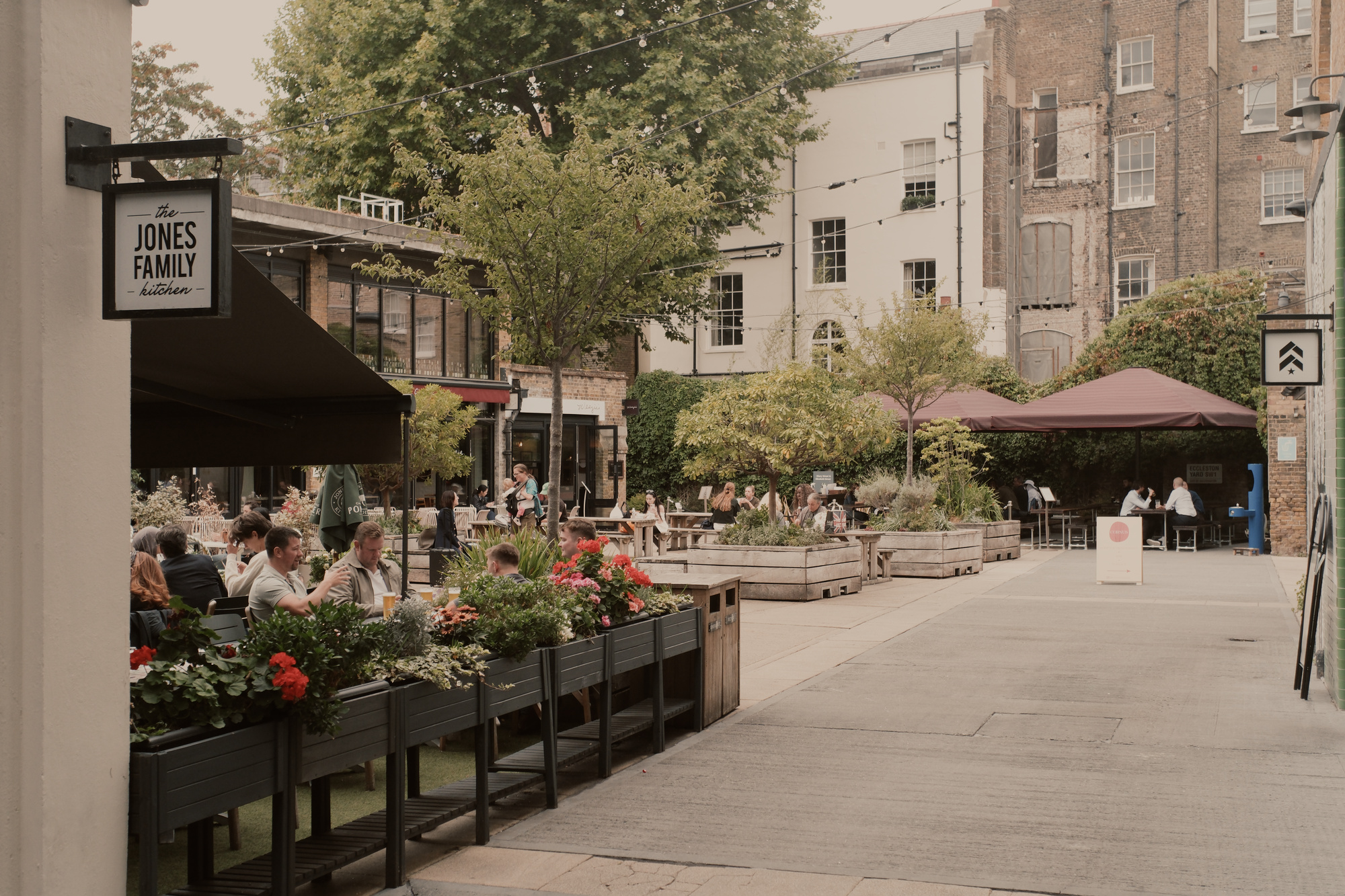
The street bends me back toward Victoria, and just before I arrive, an archway opens onto Eccleston Yards. Brick walls, string lights strung overhead, potted trees in wooden planters. The Jones Family Kitchen has tables out, and people are sitting at them — talking, eating, someone laughing at something someone else just said. It is, in its own way, another enclosed courtyard, buildings pressed close around a shared green space, not unlike the private squares I've just spent an hour walking past.
Except here, the gate isn't locked.
Victoria Station is two minutes away.